
A little about me...
I'm a Neuroscience PhD student at the University of Southern California, working in the laboratory of Dr. Katherine Matho at Children's Hospital Los Angeles. I study how neuronal identity and connectivity emerge during development, and how they're disrupted in neurodevelopmental disorders such as autism spectrum disorder. I'm particularly interested in how these developmental programs may set the stage for healthy brain aging and cognitive longevity.
Before grad school, I spent three years as a Research Data Analyst at the Stanford Poston Lab, where I studied how blood-based biomarkers predict differential rates of cognitive decline across neurodegenerative etiologies.
Science is most powerful when it's accessible — to researchers at every career stage, patient communities, and anyone curious about health and longevity. In that spirit, I'm a founding board member of the Sundial Initiative (a 501(c)(3) supporting aging and longevity research) and director of Next BioLeader (a Stanford-based career development network). Previously, I founded the California chapter of Connecting Through Art, a partnership between the American Parkinson's Disease Association and the Stanford University School of Medicine.
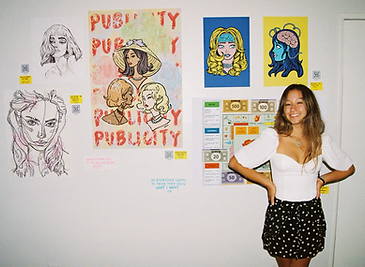

An art show out of my apartment, raising money for the Epilepsy Foundation (2021)
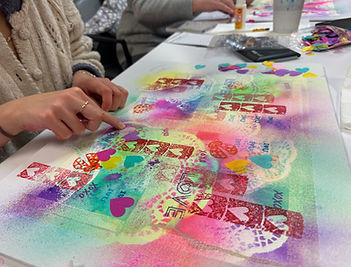

Art projects from the California Connecting Through Art series (2023-2025)
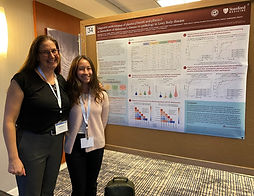

Presenting my project next to my mentor Kathleen Poston, MD, MS (2024)
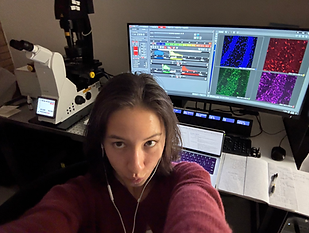
Imaging the mouse dentate gyrus (a structure in the hippocampus) at 20x magnification (2026)

Flew out to Seattle for a cell types workshop at the Allen Institute! (2026)

Acrylic on canvas, 3 x 4 ft. (2022)


... a little more
Maybe the best way to explain who I am is to start with how I got here.
Art has always been my way of spinning an internal thread into a form other people could understand. Sticky feelings are best conveyed when scrawled and plastered onto paper, in my opinion. Around the time I started getting serious about pursuing art school, my brother was diagnosed with epilepsy. Upon learning how neurons communicate with each other, I was struck by how a binary firing pattern bestows the complexity of the human experience — the richness of the five senses, the pirouette of a ballerina, but also the chaos of a grand mal seizure. I wanted to understand the invisible biological events that govern how we experience life.
I've since chosen a career in neuroscience, aiming to understand the biological and cognitive substrates of the human experience. That search started in undergrad as a research assistant at the USC Brain & Creativity Institute. There, I helped investigate how intergenerational storytelling helps teens connect daily experiences to their broader sense of purpose, like how my grandma sharing about being the only girl in her 8th-grade class helped me understand that education is a privilege. During this time, I independently studied adaptive therapies for Parkinson's disease, ultimately designing an art therapy program that addresses motor symptoms by inspiring alternative forms of self-expression. Both projects taught me that neurobiology and cognition aren't separate stories: they're the same narrative told at different scales.
Aching for that finer scale, I spent three years at the Stanford Poston Lab studying biological markers of neurodegenerative disease. These biomarkers are molecular signals in the body that can aid clinical decision-making, much like how cholesterol levels offer a window into your heart health. I led a project showing that a blood-based marker (called plasma pTau217) can accurately detect Alzheimer's disease co-pathology in people with Lewy body disease, reducing the need for invasive testing (like spinal taps or PET scans) for roughly half of these individuals. But the more I worked in this space, the more I found myself asking a question my data couldn't answer. Aging looks different for everyone: what makes some brains more resilient to aging and neurodegenerative disease than others?
In 2025, I returned to USC to chase that question (and a PhD in Neuroscience). Using mouse models, my early lab rotations explored hormone therapy and endurance exercise as ways to protect the aging brain from Alzheimer's disease. I noticed that many longevity-promoting interventions act on the brain's ability to replenish and regenerate compromised cells amidst biological aging and neurodegenerative processes. That insight pulled my whole research question earlier in the lifespan: at what time point do we even start to define risk or resilience? ...And better yet, do something about it?
My guiding hypothesis now is that how the house is built up may largely influence how it eventually falls apart: the developmental programs that wire our brain circuitry during development may set the stage for our vulnerability to age-related diseases decades later. I've joined Dr. Katie Matho's lab at Children's Hospital Los Angeles to investigate how temporally regulated gene expression during embryonic development specifies the identity and connectivity of cortical neurons, and how disruptions in this process (particularly autism spectrum disorder risk genes) contribute to neurodevelopmental dysfunction. I'm particularly interested in how the establishment and refinement of neuronal identity and connectivity "starts the clock" for brain aging, with the long-term hope of informing longevity interventions based on these developmental programs.
Science is one way I've tried to understand the human experience. Art has been the other. My art is largely an exploration of identity as I've grown into adulthood, reflecting how incredibly nonlinear this journey of "finding myself" has been. As this website (and my free time) creeps further and further away from art, the impulse behind it stays exactly the same: to keep asking what it means to be human, in all the ways I know how.
I hope you'll join me on this endeavor!
With love always,
Alena